Ironman coaching · Inspirational speaking
Twenty-six minutes late. Then five minutes to spare.
On 26 July 2010, I crossed the line at Ironman Lake Placid at 12:26 in the morning — twenty-six minutes after the course closed. Three years later, on 12 October 2013, I finished the Ironman World Championship in Kailua-Kona at 11:54:28 at night, with five minutes and thirty-two seconds left before the cut-off.
Everything I speak about and everything I coach lives in the gap between those two nights.
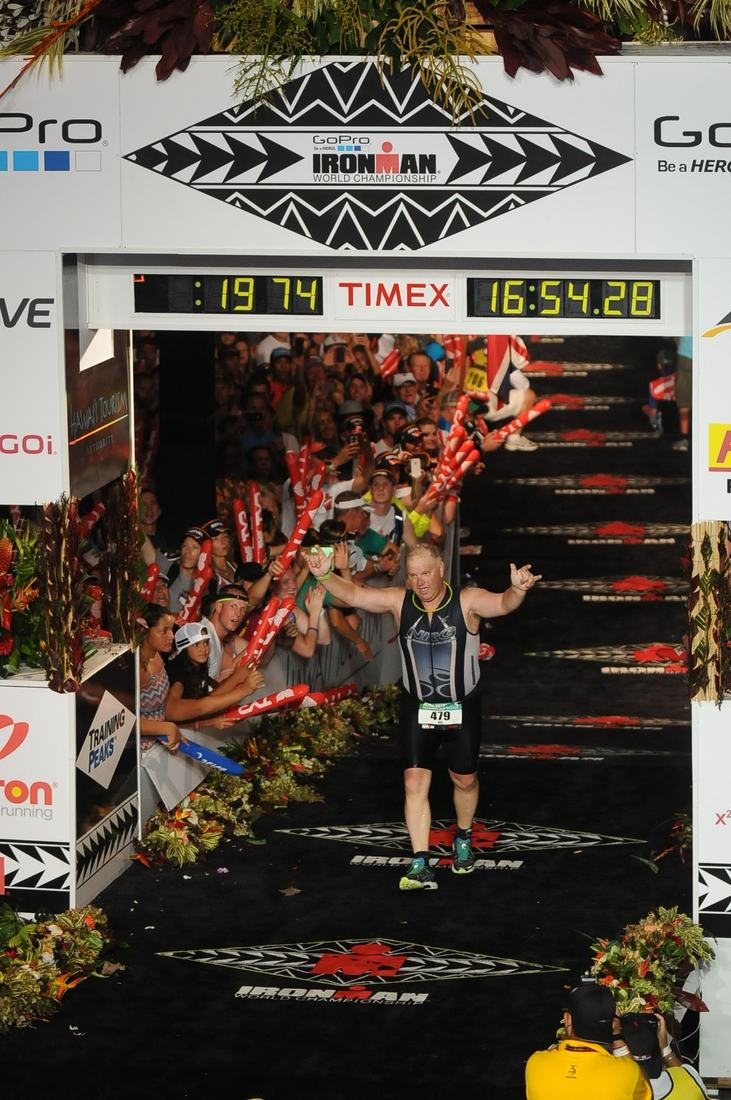
12 October 2013 · 16:54:28
Ironman finishes, including the World Championship in Kona
Ironman 70.3 finishes
Marathons — three Disney, one Chicago, two London
Kona finish time, with 5:32 to spare
Prepared · Confident · Determined
Prepared
An Ironman year is 215,000 metres of swimming, 3,300 miles on the bike, 600 miles of running and more than 500 hours. None of it is heroic. All of it is planned, and the plan is what carries you when the day goes wrong.
Confident
Confidence is not a personality trait you either have or lack. It is the residue of work you have already done and evidence you can point to. We build it deliberately, session by session.
Determined
At some point the plan stops helping and you have to decide. Most people never find out what they will do at that moment because they never get close enough to it.
Never Stopped Believing
“If you can’t find a way, make a way.”
The Journey of an Unlikely Ironman — a keynote about belief, preparation and the moment a plan runs out, told through a fifty-year-old accountant who had no business being on that start line and finished anyway.
It is not a sports talk. It is about what any demanding life asks of you: examining how you do what you do, being accountable to the people who depend on you, breaking impossible things into pieces small enough to start, and finding the one per cent you can improve this week.
Who I coach
- First-timers who have entered something that frightens them and have no idea where to start
- Athletes who have missed a cut-off and are deciding whether to go back — my particular specialty, for obvious reasons
- Executives and business owners fitting serious training around a job that does not care about their training
- Age-group athletes chasing a qualifying time, a distance step-up, or a finish that has eluded them
- Anyone who was told, or told themselves, that they are not an athlete
I am an Ironman Certified Coach and I charge no fee. Instead, athletes donate the equivalent of one Buffalo Bicycle a month to World Bicycle Relief. It is how I give back for a sport that changed my life.
What’s your why?
Whether you want a speaker for your conference or a coach for a start line you are afraid of, the first conversation is the same one: why this, and why now.
Inspirational speaking
Never Stopped Believing
The Journey of an Unlikely Ironman. A keynote about belief, preparation, gratitude and the moment your plan runs out — built for audiences who will never swim 2.4 miles and will absolutely recognise the feeling.
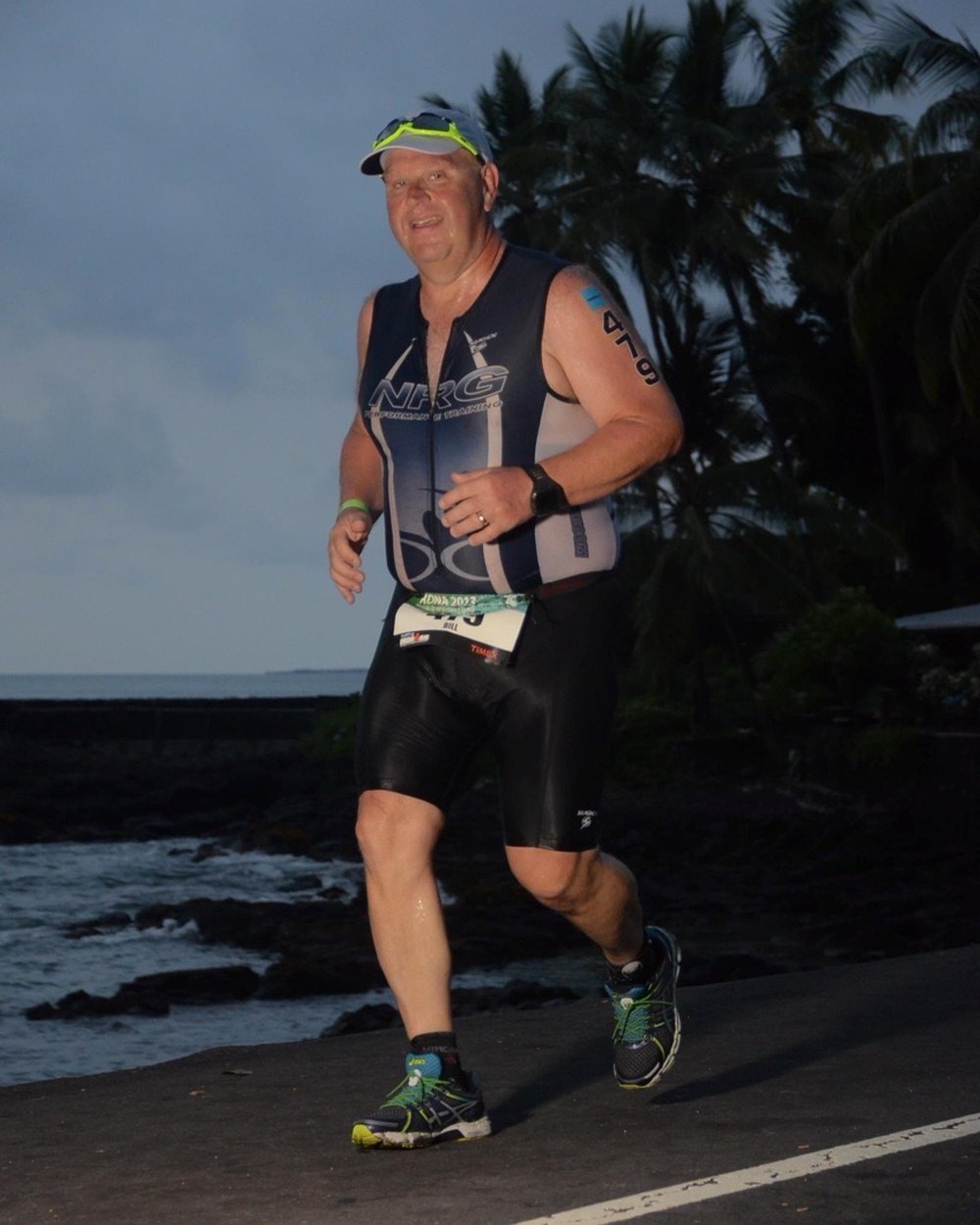
How the talk moves
A dream that started in the hours before midnight in July 2008, and a sign on a wall that said if you can dream it, you can do it.
The fuel: people, places, lessons and memories — and why the ones who carry your bag matter more than the ones who hand you the medal.
What’s my why? Then, unavoidably: what’s yours? The question the rest of the talk hangs on.
Sister Madonna Buder, Chris Nikic, Hector Picard. Three people who redefined what the word impossible is worth.
Why inspiration has to be sought out rather than waited for, and what it costs to go looking.
Planning and preparation. Commitment and consistency. Organisation and structure. The unglamorous foundation under every finish.
Seventy seconds before a swim start, and what the day does to a plan that took a year to build.
The spot on the Big Island where it came apart, and the decision that followed. If you can’t find a way, make a way.
Why it lands with a business audience
The bridge is not motivational. It is structural — because a demanding job asks for exactly what a long day of racing asks for:
- Work and personal lives that are complex, demanding and running at the same time
- Constant examination of how we do what we do — our actions, habits, practices and processes
- Tracking and evaluating performance honestly, recording the highs and the lows
- Accountability, to ourselves and to the people who depend on us
- Breaking things down and simplifying them until they can actually be started
- Looking consistently for incremental gains — the one per cent that compounds
What is your increment?
Eight lessons the audience leaves with
- Find and have a purpose. Everything else is negotiation without one.
- Do the work — measure twice, cut once. Preparation is not the boring part; it is the part.
- Own and learn from your mistakes. Mine cost me twenty-six minutes and three years.
- Maintain focus. It keeps you on track, keeps you safe, and gets it done.
- Always finish what you start. Including the things nobody is watching.
- Have gratitude. For the people who made it possible, every time.
- Find joy in the journey. The finish line lasts a few seconds; the years before it do not.
- Never stop believing. Which sounds like a poster until the night it is the only thing you have left.
Ways to book it
| Format | What it is | Length |
|---|---|---|
| Conference keynote | The full talk, with photography throughout and time for questions at the end. | 45–60 min |
| After-dinner | A tighter, warmer version built for a room that has eaten well. | 30 min |
| Leadership offsite | The keynote plus a facilitated session on the audience’s own why, increment and follow-through. | Full day |
| Sports club or team | For triathlon clubs, running groups and school or university squads. | 45 min |
| Fundraiser | Delivered at cost for events supporting World Bicycle Relief and similar causes. | By arrangement |
Fees: US$5,000, of which 20% goes to World Bicycle Relief. Travel from Chicago billed at cost. Fundraisers and club events by arrangement.
What audiences say
I know we had a great line-up of speakers, but your talk may well have been my favourite. I appreciated the sincerity and humility you displayed while delivering a powerful message.
Mark G.I frankly didn’t know what to expect from this segment and I was worried it would be lame and a waste of time — which, at the end of the night, was a real concern. It ended up being fun, and I went to the gym before cocktails because I had the motivation to go do that.
Jon E.Your unlikely story is truly amazing. What you accomplished was a complete reboot of your life and a lesson for us all. Breaking things down and keeping them simple are great tools to stay focused on what is important.
Alan T.I’ve been running “Unlikely Ironman” through my head all week. The more I contemplate my why, the more excited I am about my career and life transition. You’ve helped and inspired me.
Jay F.It was a pleasure to meet you and hear your story. You are an inspiration.
Josh D.I had no triathlon background. Ten 70.3s and two Ironmans later, Bill has become someone I genuinely look up to, and a lifelong friend.
Rashed AlNaber · Sub11 AthleticsLooking for a speaker?
Tell me the audience, the room and what you want them walking out thinking. I will tell you honestly whether this is the right talk for it.
Ironman coaching
I coach for donations, not for fees.
Every athlete I coach donates the equivalent of one Buffalo Bicycle a month to World Bicycle Relief, which puts bicycles under students, health workers and farmers in rural Africa. Nothing comes to me. It is how I pay back a sport that gave me more than I put in.
How I coach
I am an Ironman Certified Coach who came to this late and slowly. I was not a runner, I was not a swimmer, and I missed my first Ironman cut-off by twenty-six minutes at the age of fifty-one. Everything I know about getting an ordinary body to the end of an extraordinary day, I learned the hard way and in the right order.
That makes me the wrong coach for an athlete chasing a podium, and close to the right one for anybody who is afraid of the distance.
- The plan comes first. A written, periodised plan built around your real calendar, not an ideal one — because the work still has to happen on the weeks when the job explodes.
- Everything is measured. Sessions logged, performance tracked, highs and lows recorded. You cannot improve what you have not written down.
- Incremental gains. One per cent at a time, in the places it is actually available. Heat acclimation from five minutes to three hours and twenty at 105°F took six weeks.
- Preparation for the bad day. Nutrition, pacing, mechanical basics, and a rehearsed answer for the moment the plan stops working — because it will.
- Honesty. If your goal and your available hours do not agree, you will hear it early rather than three weeks out.
What a year actually costs
Nobody tells you the numbers before you enter. Here they are, from one of my own Ironman years:
| Swimming | 215,000 metres |
| Cycling | 3,300 miles |
| Running | 600 miles |
| Total training | 500+ hours |
| Race day | 2.4 mi swim · 112 mi bike · 26.2 mi run |
What coaching includes
- An initial conversation about your why, your history and your honest availability
- A written plan to your race date, reviewed and rebuilt as life interferes
- Weekly check-ins — by phone, video call, text or email, whichever suits the week
- Session-by-session feedback on what you log
- Race-week planning: travel, transition, nutrition, pacing and contingencies
- A debrief afterwards, whatever the result
In place of a fee: one Buffalo Bicycle a month — currently US$165 — donated to World Bicycle Relief. Over a season that is a handful of bicycles putting students, health workers and farmers within reach of a school, a clinic or a market. Give more if you want to and less if you need to; nothing comes to me either way. Donate to World Bicycle Relief →
From the athletes
I worked with Bill while training for multiple IRONMAN 70.3 races, and for IRONMAN Wisconsin. Completing an IRONMAN was a tremendous challenge, and I honestly don’t believe I would have been able to cross that finish line without Bill’s coaching, guidance and support.
What makes Bill such a fantastic coach is that he meets athletes where they are. Whether you are new to triathlon, preparing for your first 70.3, or working toward an IRONMAN, he takes the time to understand your abilities, your goals and your individual needs — and gives you the confidence to push yourself and accomplish things you may not have thought possible.
Dr. Mark Orszula · IRONMAN Wisconsin 2021 “
“
Bill and I started working together in 2018, and little did I know I was in for a life-changing experience. At the time I had no triathlon background and a good amount of time on my hands, and the improvement we saw was exponential.
When I became deeply involved, Bill emphasised the idea of quality over quantity, and through ups and downs I truly began to understand it. Not only did my fitness improve, I also learned so much more about nutrition and fuelling strategies during a race.
Bill also helped me loads when it came to deciding what equipment I needed to buy, given whatever budget I had at the time. Everything we decided on together was a worthy investment that I used for many years afterward.
After completing ten 70.3s and two Ironman races — and many more local races — I consider myself lucky and thankful to have met this wonderful person, whom I genuinely look up to. We developed a lifelong bond; even though we are continents apart, he really made me feel like part of his family.
Rashed AlNaber · Founder & CEOSub11 Athletics
Afraid of the distance?
Good. That is the right starting condition, and it is the one I know best. Tell me what you have entered, or what you are thinking about entering.
My story
The journey of an unlikely Ironman.
I am a chartered accountant who spent forty years in boardrooms and C-suites. I was not an athlete. At fifty I decided to become one anyway, and it took me until I was fifty-four to get it right.
Twenty-six minutes, and five minutes thirty-two
26 July 2010, Lake Placid, New York. I crossed the line at 12:26 in the morning. The clock had closed at midnight. Twenty-six minutes late, no finish, no medal, no result beside my name — and a very long drive home with a family who had stood in the dark for seventeen hours to watch it.
12 October 2013, Kailua-Kona, Hawaiʻi. The Ironman World Championship, the race every age-grouper dreams about. I came down Aliʻi Drive at 11:54:28 at night with five minutes and thirty-two seconds left on the clock. Sixteen hours, fifty-four minutes, twenty-eight seconds.
Between those two nights is everything I have to say about preparation, belief and what you do when the plan runs out.
How it went
- July 2008The dream starts
In the hours before midnight, and a sign on a wall: if you can dream it, you can do it.
- June 2009Tupper Lake Tinman, New York
First distance race. Determination to finish it, and to finish it on time.
- July 2010Ironman Lake Placid
Finished at 12:26 a.m. Twenty-six minutes after the cut-off. The race that made the rest of it necessary.
- July 2011Ironman Lake Placid
Back on Mirror Lake at 6:59 a.m., seventy seconds before the gun — and this time an official finish, on the course that had turned me away a year earlier.
- Nov 2011Ironman Arizona, Tempe
Kicked in the head on the swim. Regrouped in the water and got on with the day — the first time I found out what I would do when it went wrong early.
- Mar 2012Ironman New Zealand, Taupō
Shortened to half distance when a cyclone hit the course. You race the day you are given.
- Aug 2012Ironman Canada, Penticton
The last running of the race on the original Penticton course, in British Columbia.
- June 2013Ironman Coeur d’Alene, Idaho DNF
Missed the cut-off. Sixteen weeks later I was on the start line at Kona.
- Oct 2013Ironman World Championship, Kona
16:54:28, with 5:32 to spare. The dream, finished, on the Big Island.
- June 2014Ironman Coeur d’Alene, Idaho DNF
Heat hit 115 degrees on the same course. I walked off it for my own safety. Three months later I set my personal best at Chattanooga.
- Sept 2014Ironman Chattanooga, Tennessee
My personal best over the full distance.
- Aug 2015Ironman Mont-Tremblant, Québec DNF
Raced it ill and did not get to the end. Four weeks later I was in the water at Lake Monona.
- Sept 2015Ironman Wisconsin, Madison
Lake Monona at dawn — the calm before the storm.
- June 2018Ironman Cairns, Australia
On the beach at the swim start with my sherpa, near the Great Barrier Reef.
- April 2019London Marathon
There is always an opportunity for a selfie, even on Tower Bridge.
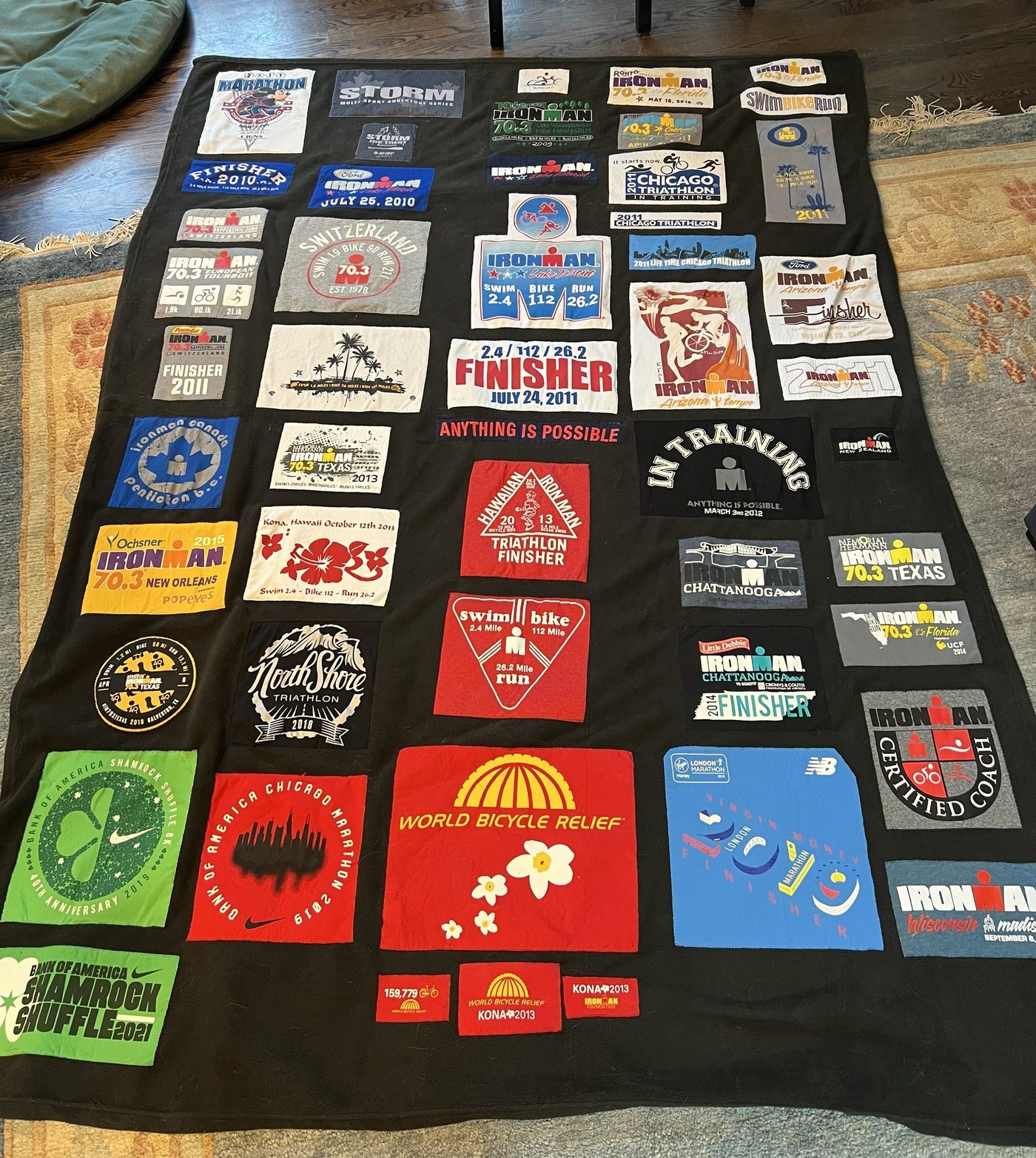
Every shirt, one blanket
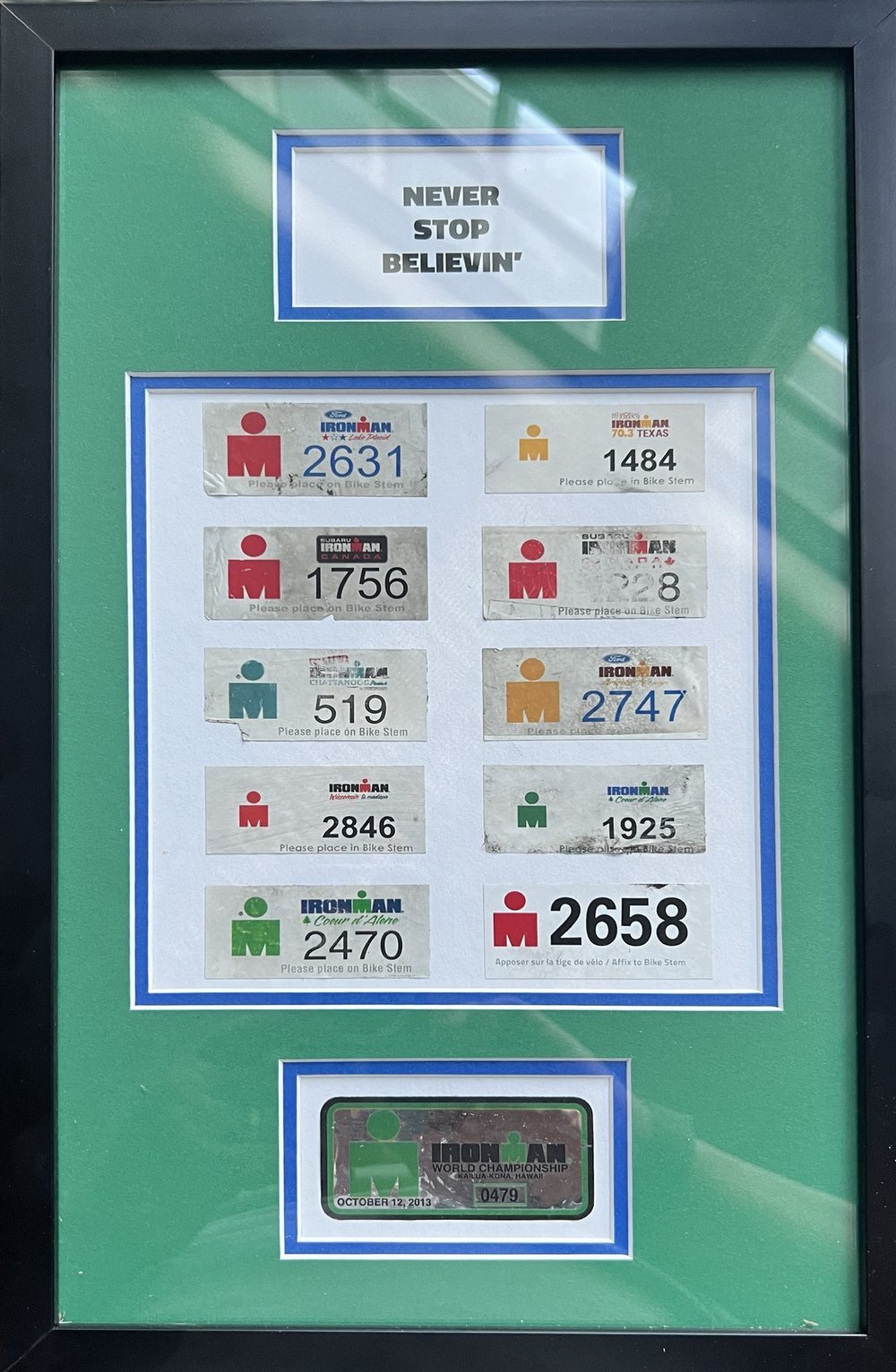
Three people who moved the line
Every time I decided something was impossible, somebody else was busy doing it. Sister Madonna Buder, racing Ironman into her eighties. Chris Nikic, the first athlete with Down syndrome to finish one, one per cent better at a time. Hector Picard, racing without arms.
None of them made my day easier. All of them made my excuses smaller.
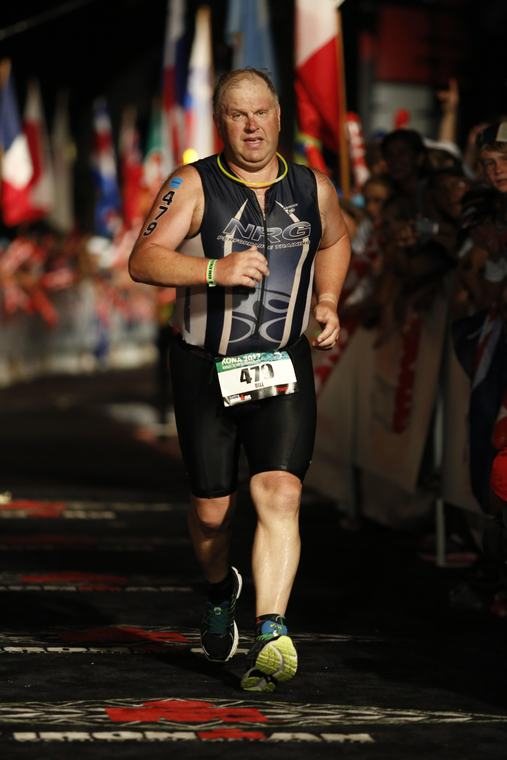
October 2013
Contact
What’s your why?
Speaking enquiry, coaching enquiry, or a question about something on this site — it all comes to me and I answer it myself.
For a speaking enquiry, tell me
- The event, the date and the room — how many people, and who they are
- What you want them walking out thinking or doing
- How long you have, and what else is on the programme
- Whether it is a commercial event or a fundraiser
For coaching, tell me
- What you have entered, or what you are thinking about entering
- What you have done before, honestly
- How many hours a week actually exist in your life
- What is making you hesitate
Every finish line started with an entry.
Mine started at eleven at night in July 2008 with no idea what I was doing.
Legal
Privacy notice
Last updated September 2026
Who this covers
Inspired Endurance Coaching, also trading as Inspired Endurance Training, is a one-person practice run by William S. Best from Evanston, Illinois. He is responsible for the personal information described here and answers questions about it himself, at coachbill@inspiredendurancecoaching.com.
What is collected
Almost nothing, and deliberately so.
- What you send. If you email or call, he holds your name, contact details and whatever you chose to put in the message. There is no form on this site — enquiries arrive as ordinary email.
- Coaching records. If you go on to be coached, the records coaching requires: your training history and availability, the plan, the sessions you log, and the correspondence between you.
- Speaking enquiries. Event details, dates, and whatever an organiser sends about the audience and the programme.
- No tracking. This site carries no analytics, no advertising tags and no cookies. Nobody is watching you read it.
A note on health information
Coaching involves telling a coach things about your body — injuries, illness, what you can and cannot do this week. That information is used to write and adjust your plan and for nothing else. It is never shared with an employer, a club, a race organiser or anyone else without your say-so, and it is not used in talks, articles or case studies unless you have agreed in writing and seen the wording first.
How it is used
- To answer your enquiry and work out whether this is a sensible fit
- To write, review and rebuild your training plan, and to give feedback on what you log
- To plan and deliver a speaking engagement
- To keep the ordinary records a small business has to keep
Your information is not sold, rented, or used to market to you. There is no mailing list. Coaching is paid for by donation to World Bicycle Relief and no money passes through this practice, so there are no payment details held here.
Who else sees it
Email and files are held in Google Workspace. This website is hosted by Netlify, whose servers keep routine access logs as any web host does. Nothing else is shared, and information is disclosed otherwise only where the law requires it.
Where it is held, and for how long
Information is held in the United States. Coaching records are kept for two years after coaching ends, in case you come back. Enquiries that go nowhere are deleted within twelve months.
Your rights
You can ask what is held about you, ask for it to be corrected, or ask for it to be deleted. Write to coachbill@inspiredendurancecoaching.com and you will get a reply within thirty days. Residents of Canada have these rights under PIPEDA; residents of the EU and UK have broader rights under the GDPR, including the right to complain to a supervisory authority.
Children
Coaching is offered to adults. Where an athlete is under eighteen, a parent or guardian is party to the arrangement and to everything held about them.
Changes
If this notice changes, the date at the top changes with it.